
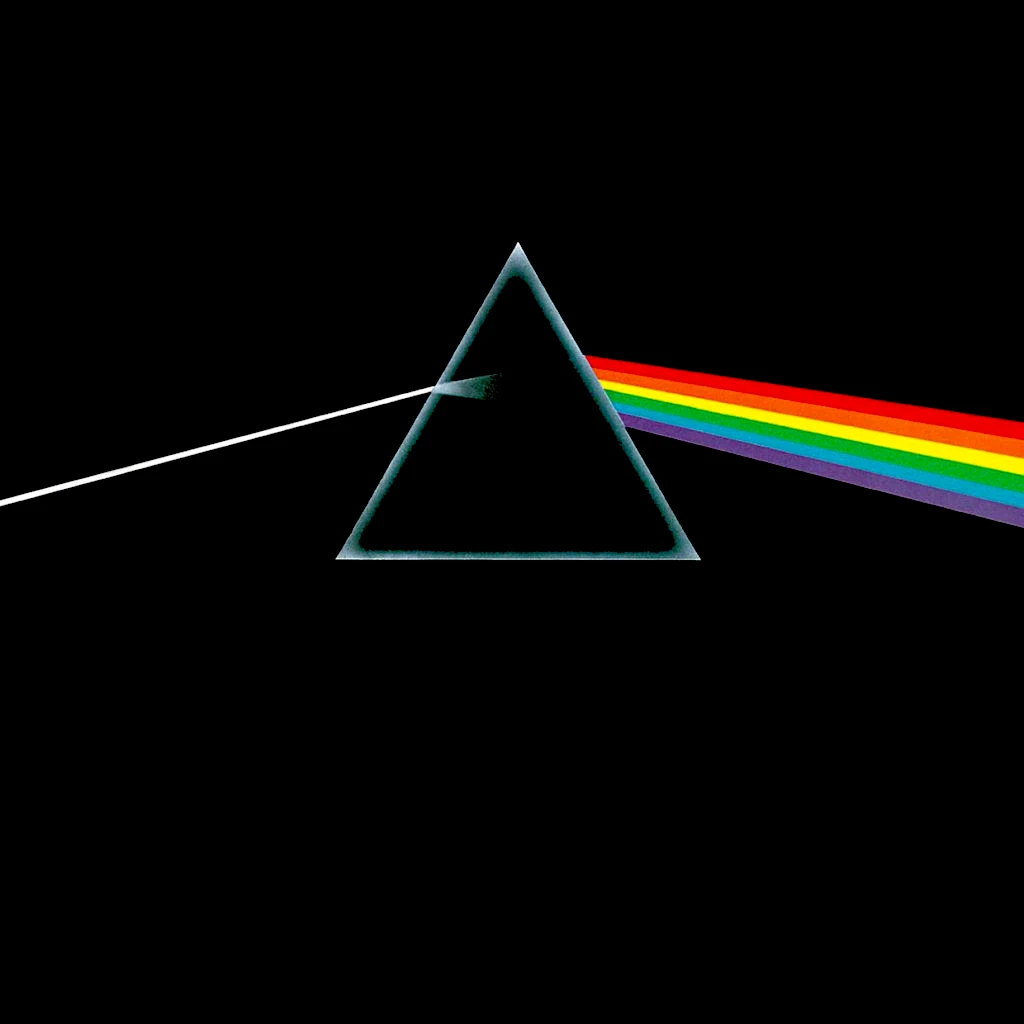
Released in March 1973, The Dark Side of the Moon is the eighth studio album by the British band Pink Floyd. Published by Harvest Records and produced by the band with Alan Parsons as sound engineer, the album is a masterpiece of progressive rock and one of the best-selling and most influential records in music history. It features Roger Waters, David Gilmour, Richard Wright, and Nick Mason, combining ambitious songwriting, universal themes, and sonic innovation.
In the early 1970s, progressive rock was on the rise, with bands like Genesis, Yes, and King Crimson. Pink Floyd distinguished itself with a conceptual approach, incorporating sound effects, electronic experimentation, and multichannel recording.
The album's themes reflect the social and psychological concerns of the time: alienation, social pressure, internal conflict, and human fragility. The album captures the unease and tensions of industrialized societies in the 1970s.
Sound engineer Alan Parsons played a pivotal role in the album's sonic quality. His work on effects, multitrack recording, and spatialization contributed to creating an immersive and cohesive soundscape.
The album utilizes analog synthesizers, magnetic tape, reverb and delay effects, as well as spoken-word recordings. These techniques allowed for a musical and narrative continuity unprecedented at the time.
The Dark Side of the Moon is a concept album, where the tracks flow seamlessly into one another. This continuity enhances the immersive experience and thematic cohesion around life, death, money, and madness.
The album combines progressive rock, jazz, experimental music, and elements of electronic music. The rich harmonies, improvisations, and sonic textures create a balance between accessibility and musical sophistication.
Roger Waters' lyrics address daily stress, alienating work, and social pressure. Tracks like "Time" and "Money" illustrate these issues with precise lyrics and expressive sounds.
The album also explores psychological fragility, depression, and madness, particularly in "Brain Damage" and "Eclipse." These universal themes contribute to the work's timeless quality.
The Dark Side of the Moon questions mortality and the meaning of existence, offering a philosophical and musical reflection on the human condition.
Among the standout tracks are "Speak to Me," "Breathe," "Time," "Money," "Us and Them," "Brain Damage," and "Eclipse." Each track fits into a fluid narrative and contributes to the album's conceptual experience.
Upon its release, the album met with immediate critical and commercial success, quickly reaching the top of the UK and US charts. It was acclaimed for its sonic innovation, conceptual cohesion, and meticulous production.
The album has had a lasting influence on progressive rock, electronic music, and ambient music. Its production techniques, sonic arrangements, and conceptual storytelling have become benchmarks for numerous artists.
The Dark Side of the Moon regularly appears on lists of the greatest albums of all time and remains a model of technical and artistic perfection. It is studied for its cultural impact, musical complexity, and immersive experience.
Through its unique combination of sonic innovation, universal themes, and masterful production, the album redefined the standards of progressive rock and concept music. Its enduring commercial and critical success, as well as its influence on several generations of artists, make it an essential part of music history.